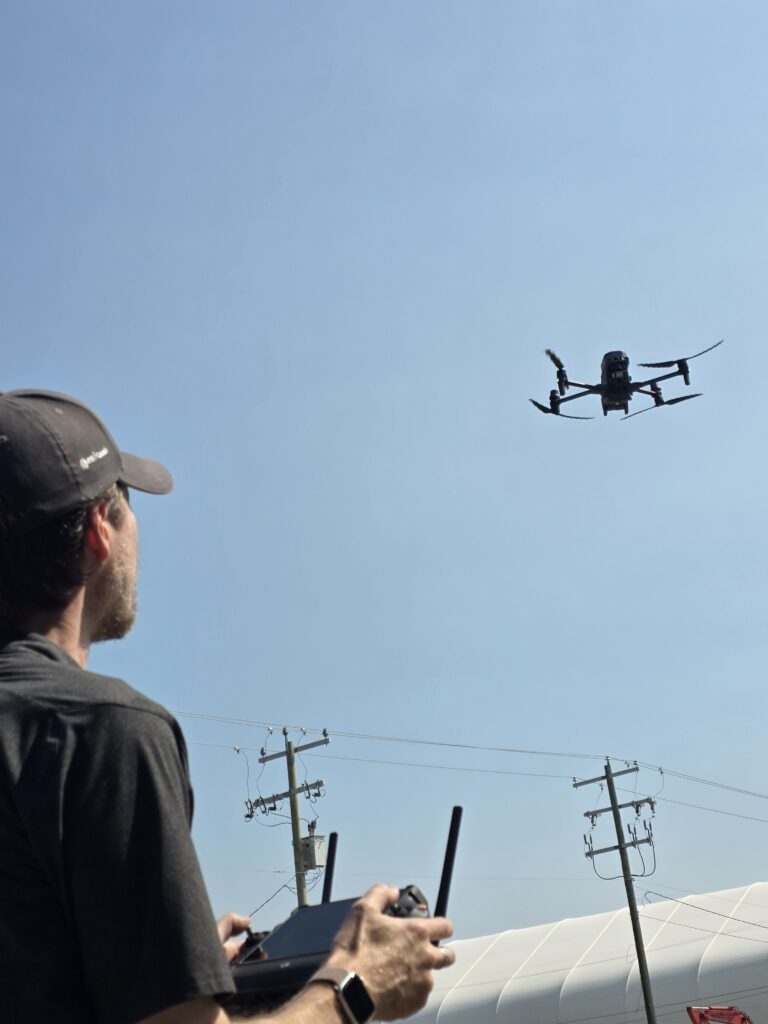
Camrose Police Service (CPS) continues to utilize opportunities for improving the highest level of service to the citizens of Camrose.
One of those opportunities includes the deployment of a Remotely Piloted Aircraft System (RPAS) more commonly known as drones.
From a front-line perspective, the use of a drone, or RPAS, is another tool members can use to enhance our delivery of public safety services in a variety of ways.
Whether they are deployed to monitor large gatherings or search for missing persons and fires in Camrose’s vast network of parks and trails in the valley, they can cover a given area so much faster than boots on the ground which can be life saving in certain circumstances, not to mention the ability to focus and expedite resources efficiently. RPA’s are also useful in complimenting patrols of areas in our city that are experiencing higher crime rates, or to mitigate risk to officer safety by providing a line of sight for assessment of dangerous situations.
While there may be misconceived notions, there is no intent behind police use of a RPAS for “spying” or searching without proper authority. The use of an RPAS is strictly governed as an investigative aid and not an invasion of our community’s privacy.
Legislation and CPS policy assures that officers adhere to the same authorities they are afforded for any other investigations or policing activities. CPS RPAS pilots are required to complete formal training and obtain piloting certification through Transport Canada to operate one of our service’s RPAS.
How they work
With regards to technical parameters, CPS operates a fleet of aircraft with varying abilities. Our flagship can fly up to 120m above ground, has upwards of 2km of range, is equipped with high resolution cameras with up to 200x zoom capabilities and can fly day or night. It boasts an infra-red thermal camera ideal for night missions.
The flagship can fly at speeds of up to 80km/h and operate in winds up to 50km/h. It is also weather rated to operate in rain and snow as well as temperatures down to -20C. It has a loudhailer and searchlight option or can be equipped with a parachute for safe operations above people.
Parachute or not, pilots always avoid flying directly overhead of people whenever possible. It’s an extremely safe aircraft with many redundancies built-in. The flagship has flown nearly 60 hours since its introduction in 2024, all without any incidents.
CPS also has the ability to live-stream the video feed form the aircraft to incident command in real-time for enhanced situational awareness and coordination. The smaller aircraft have more limited imaging, weather and accessory capabilities but are much more portable and quick to deploy in emergent situations and can even be used indoors if required.